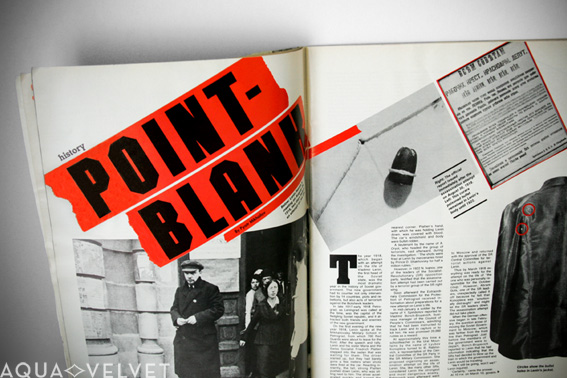
Point Blank | Soviet Life, January 1988
by Pyotr Mikhailov
Multi-page article regarding the assassination attempt on Vladimir Lenin—the first head of the Soviet state—August 30, 1918. Reportedly, the poisonous bullet remained in Lenin’s body until 1922.
. . . . . . . . . . . . . . . . . . . . . . . . . . . . . . . . . . . . . . . .
Earlier this month I featured logotypes of the Soviet press scanned from my May 1987 copy of the historic Cold War propaganda publication Soviet Life. Above and below are intriguing spreads from another SL in my collection, January 1988. This issue chronicles the 70th anniversary of the October Revolution celebrated with gusto the previous year.
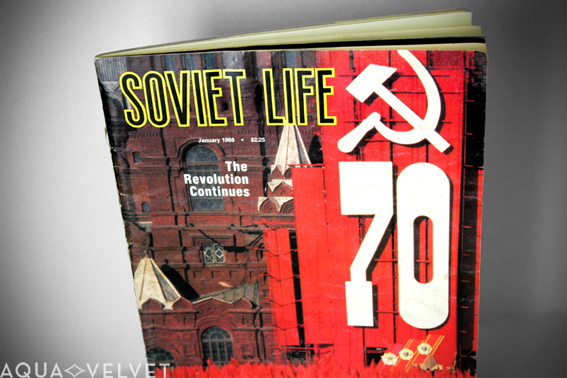
October & Perestroika: The Revolution Continues | Soviet Life, January 1988
. . . . . . . . . . . . . . . . . . . . . . . . . . . . . . . . . . . . . . . .
In October 1956, the Soviet and US Governments agreed to allow each other to publish a magazine in their own nation, but limited circulation to 30,000 copies per issue. The Soviet Government published a magazine entitled Soviet Life (formerly called The USSR, now called Russian Life), while the US Government published Amerika.
Soviet Life was generally not a political magazine, in the sense that it rarely delved into the political issues of the day, nor did it talk about political theory, etc.* Instead it focused on Soviet culture (including national minorities), science, education and health care. The last issue of Soviet Life was published on December, 1991. –Marxists.org
*Most SL issues may not have delved into political topics, but certainly this January 1988 issue did. It is a contrast to my other copies that are largely focused on the Soviet arts, culture and/or humanitarian projects. Possibly as the Soviet Union was crumbling rapidly at this stage, they were pulling out all the stops as part of a last ditch effort to glorify their dying political machine. Or simply they were keyed up from their 70th anniversary celebrations.
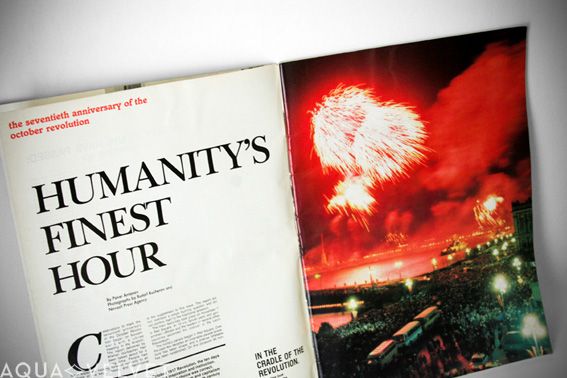
Humanity’s Finest Hour | Soviet Life, January 1988
by Pavel Antonov
Multi-page article featuring the festivities surrounding the 70th anniversary of the USSR. Celebrations began November 2, 1987 with the main festivities taking place on November 7th in Red Square.
. . . . . . . . . . . . . . . . . . . . . . . . . . . . . . . . . . . . . . . .
Today we address ourselves to the October 1917 Revolution, the ten days that shook the world, where we find both inspiration and instruction. Again and again we realize that the socialist choice was correct. The year 1917 proved that the choice between socialism and capitalism was the chief social alternative of our era, that in the twentieth century we progress only when we are seeking a higher form of social organization, socialism. This fundamental conclusion made by Lenin is as valid today as it was in his day.
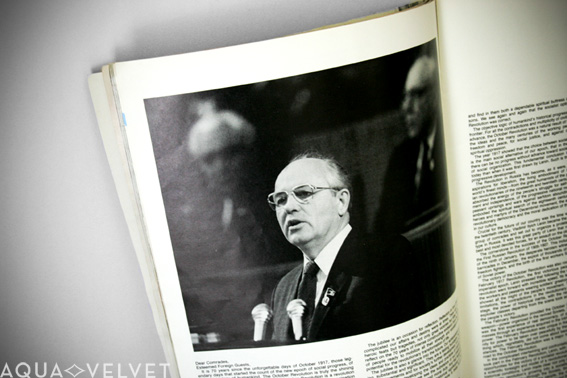
The Revolution Continues | Soviet Life, January 1988 | Photo of Mikhail Gorbechev
. . . . . . . . . . . . . . . . . . . . . . . . . . . . . . . . . . . . . . . .
[...] the full text of the report by the General Secretary of the Central Committee of the Communist Party of the Soviet Union at the jubilee meeting of the Central Committee of the CPSU, the Supreime Soviet of the USSR and the Supreme Soviet of the Russian Federation to mark the seventieth anniversary of the Great October Socialist Revolution, November 2, 1987.
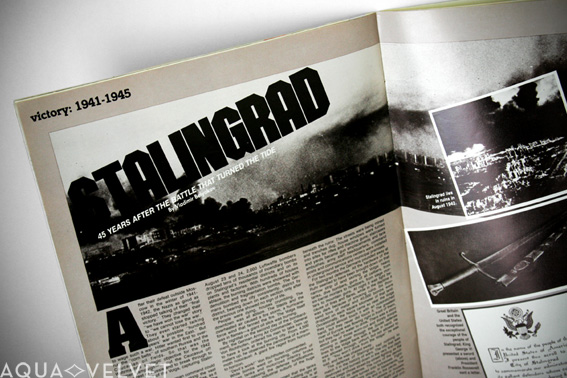
Stalingrad: 45 Years After the Battle that Turned the Tide | Soviet Life, January 1988
by Vladimir Belyakov
. . . . . . . . . . . . . . . . . . . . . . . . . . . . . . . . . . . . . . . .
In mid-August (1942) news spread around the world about a major German push toward Stalingrad. The half-million-strong army, with 1,500 tanks to support it, crossed the Don River and rolled on across the steppe toward Stalingrad, which at that moment had no more than a small garrison to defend it. The Wehrmacht generals felt sure it was bound to fail—they saw no way for the Russians to hold it on a narrow strip of land with no room for maneuver. The Germans felt Stalingrad was a sitting duck. But the Russians thought differently…
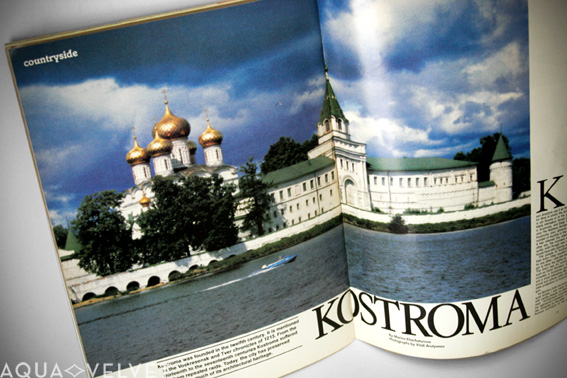
Kostroma | Soviet Life, January 1988
by Marina Khachaturova – photographs by Vitali Arutyunov
Multi-page article on the city of Kostroma which was founded in the 12th century. Although suffering repeated raids through the 13th to 17th centuries the city has preserved much of its architectural heritage according to this piece.
. . . . . . . . . . . . . . . . . . . . . . . . . . . . . . . . . . . . . . . .
Kostroma is a truly Russian town and that is the reason directors use it as the location for films in which the action is set inold Russia or in the provinces. [...] Kostroma also attracts a large number of tourists in the summer. It has retained the charm of another era, the coziness and tranquility, even though new neighborhoods have also sprung up.
. . . . . . . . . . . . . . . . . . . . . . . . . . . . . . . . . . . . . . . .
For further reading:
>> Russian Life magazine – Wikipedia.org
>> Soviet Life magazine – Marxists.org
>> Amerika magazine – Wikipedia.org
>> The Press: The Voice of Amerika – 1949 TIME Magazine article
>> The Press: A Red Victory? – 1952 TIME Magazine article on the demise of Amerika magazine
. . . . . . . . . . . . . . . . . . . . . . . . . . . . . . . . . . . . . . . .


